Pro FeedCoaching
Mastering the ATP Forehand: Entering "The Slot"
The biggest lie in club tennis is the "windshield wiper" or "brush up" cue. Most intermediate players try to create spin by swinging strictly vertically, barely grazing the back of the ball. To hit like Sinner or Alcaraz, you need to understand that spin is a byproduct of compression, not just friction. Mastering "The Slot" allows for maximum potential energy and a lethal combination of pace and dip.
AceFinder Technical Team
Last updated March 1, 2026 • 1 day ago • 3 min read
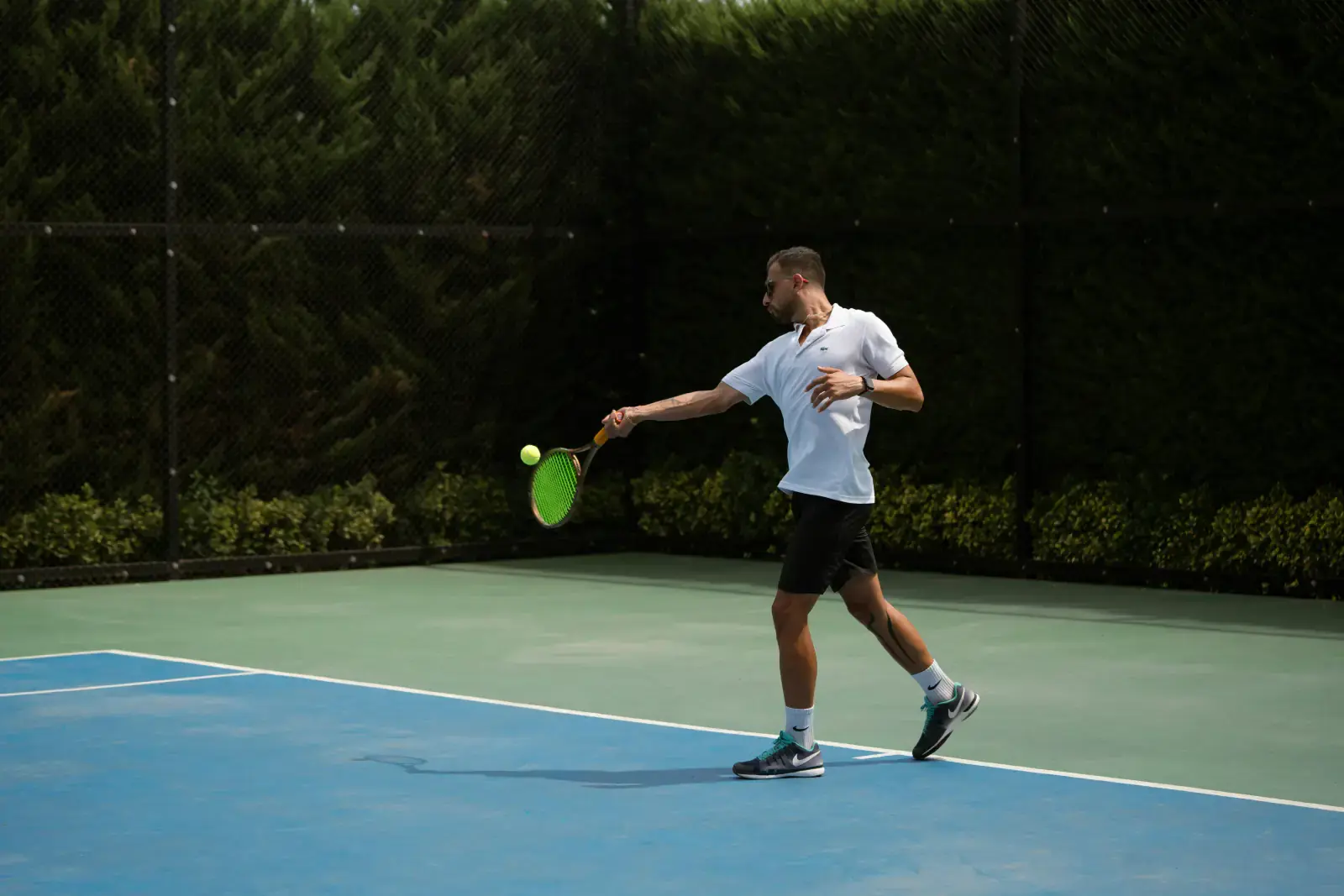
The Myth: Stop "Brushing" Up
The biggest lie in club tennis is the "windshield wiper" or "brush up" cue. Most intermediate players try to create spin by swinging strictly vertically, barely grazing the back of the ball. This results in a weak, loopy shot that lands short. To hit like Sinner or Alcaraz, you need to understand that spin is a byproduct of compression, not just friction.
The Mechanics: Finding "The Slot"
Before the forward swing begins, you must find The Slot. As your hips begin to rotate forward, the racket head must drop below the level of the ball while the wrist remains "laid back" (extended).
In this position, the butt cap of the racket points toward the ball. This creates a massive Stretch-Shorten Cycle in your forearm and chest. The Slot isn't a static pose; it’s a moment of maximum potential energy where the racket is trailing the hand, ready to snap forward like a whip.
Hitting "Through the Tube"
Once you leave the slot, the goal is Linear Extension. Imagine the ball is sitting inside a long cardboard tube pointing toward your target. You must drive your racket face through that entire tube before following through.
The Physics of the Heavy Ball: When you hit through the ball with a slightly closed face, you compress the felt and the core. This is why pros using the Yonex VCORE 98 or the Wilson Blade 98 can generate such heavy shots—they are driving through the ball. This "dwell time" on the strings actually generates more RPMs (Revolutions Per Minute) than a thin, vertical brush. By driving through the ball, you get the "Heavy Ball" effect: maximum pace combined with the dip and kick of elite topspin.
The Drill: The "Three-Ball Train"
To master this feeling of extension, use this visualization on the practice court:
Imagine three tennis balls lined up in a straight row, spaced 6 inches apart, pointing toward the net.
The Goal: Your swing path must be flat and long enough to "strike" all three balls in a single line.
The Result: This prevents you from pulling "up and off" the ball too early. If you hit through the "train," your depth will increase instantly, and the ball will "explode" off the court.
Sources & Technical References
- Journal of Sports Sciences: Biomechanical Analysis of the Forehand Drive in Elite Tennis Players. View Source
- Human Movement Science: Stretch-Shorten Cycle Utilisation in Tennis Forehand Strokes. View Source
- ITF Coaching Review: Linear vs. Rotational Swing Paths—Ball Compression and Spin Generation. View Source
AceFinder PickEst. £220 - £240
VCORE 98 2023/24
305g 98" 16x19
Recommended for you


Technical Data Pairs
Match your swing speed to a frame.
Our lab-data analyzer compares your biometric inputs against 2026 racket physics.
Launch Racket Finder