Pro FeedGear
The "Swingweight" Deception: Why Static Weight is the Ultimate Racket Myth
Swingweight is the most misunderstood metric in tennis. While static weight tells you how heavy a racket feels in your hand, swingweight (the moment of inertia) tells you how heavy it feels when you are actually playing. A 300g racket with a high swingweight will hit harder and feel more stable than a 315g racket with a low swingweight. For advanced players, matching swingweight across frames is critical for rhythmic consistency. Our 2026 lab data shows that a swingweight deviation of more than 5 points is enough to disrupt the timing of an ATP-level swing path.
AceFinder Technical Team
Last updated February 26, 2026 • 2d ago • 6 min read

Player Type vs. Target Swingweight
| Spec | Why It Matters | Player Profile |
|---|---|---|
| Static Weight | Fatigue and Hand Speed | Counterpunchers |
| Swingweight | Plow-through and Stability | Aggressive Baseliners |
| Balance | Maneuverability at the net | All-Court Players |
| Player Type | Rec. Swingweight | Benefit | Best For |
|---|---|---|---|
| Defensive Baseliner | 315 - 325 | Maximum Manoeuvrability | Counter-Punchers |
| All-Court | 325 - 335 | Blend of Power & Speed | Creative Attackers |
| Aggressive Baseliner | 335 - 345 | "Heavy Ball" Physics | Power Hitters |
| Pro / Elite | 345+ | Unstoppable Plow-Through | ATP/WTA |
You're Buying the Wrong Rackets
Stop looking at the sticker on the throat of your frame. That "300g" or "305g" measurement is a comforting lie told by manufacturers to make rackets feel accessible on a retail shelf. While you've been obsessing over static weight, you've been ignoring the only metric that actually dictates how a racket performs at 80mph: Swingweight.
The Hammer vs. The Ruler
Static weight is simply how much an object weighs on a kitchen scale. Swingweight, however, is Moment of Inertia—it is the measurement of how heavy that object feels when it is actually in motion.
Think of a hammer versus a long wooden ruler. They might weigh the exact same on a scale, but try swinging the hammer by the head versus the handle. Because the mass is distributed toward the tip, the "effective weight" in motion is massive, whereas the ruler feels like nothing.
This principle explains why a Yonex VCORE 98 feels faster through the air than older frames, despite having substantial mass.
Why Your "Light" Racket is Failing You
If you feel like your racket "flutters" or gets pushed back when you're facing a heavy hitter, you don't have a technique problem—you have a swingweight problem. A low Moment of Inertia means the ball has more "authority" over the racket than the racket has over the ball.
Higher swingweight creates the "Plow-Through" effect, where the frame acts like a freight train, crashing through the contact point without deviating from its path. This stability is what allows you to turn a 90mph serve into a controlled, deep return without your wrist absorbing the shock—a trait heavily favored by Wilson Blade 98 users.
The Pro Secret: The 340+ Club
Retail rackets are designed for the masses, usually hovering around a "safe" swingweight of 315 to 320 kg·cm². This is why your game feels like it hits a ceiling; you are playing with a toy compared to the weapons used on the ATP Tour.
Most professionals play with customized swingweights of 340 to 360+. They don't care if the static weight is "heavy" because they know that mass-in-motion is what generates effortless depth and handles the modern game's extreme topspin.
How to Fix Your Frame
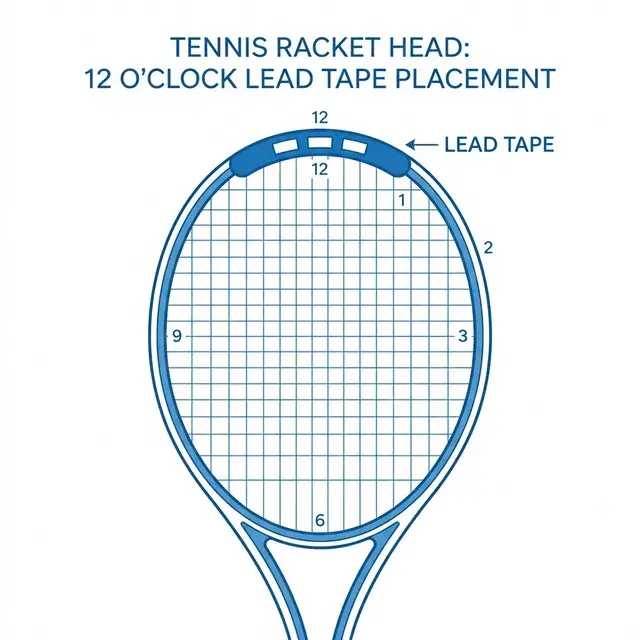
Stop shopping for a new racket and start "tuning" the one you have. The easiest way to transform a flimsy frame into a weapon is to add lead tape at the 12 o'clock position (the very tip of the hoop).
Adding just 3-5 grams of lead at the tip can increase your swingweight by 10-15 points. This shift moves the balance point toward the head, giving you the "hammer" effect needed to dominate the baseline.
Sources & Technical References
- Impacting Tennis: Effect of Racquet Specifications on Tennis Performance: Swingweight vs. Recoil Weight. View Source
- Tennis Warehouse University: The Physics of Swingweight and Its Impact on Ball Speed. View Source
- Applied Sciences Journal: Recommendations for estimating the moments of inertia of a tennis racket. View Source
AceFinder PickEst. £235 - £255
VCORE 98 2026
305g 98" 16x19
Recommended for you


Technical Data Pairs
Match your swing speed to a frame.
Our lab-data analyzer compares your biometric inputs against 2026 racket physics.
Launch Racket Finder