Pro FeedGear
The 2026 Definitive Guide to Court Pace Index (CPI): Racket & String Optimization
In the 2026 landscape, the ITF Court Pace Rating (CPR) and the Hawk-Eye Court Pace Index (CPI) are the two most critical data points for gear selection. CPR measures the surface friction, while CPI factors in barometric pressure, temperature, and ball age to determine how fast the court actually plays. Failing to align your equipment to local CPI can cause a measurable 15% drop in on-court performance.
AceFinder Technical Team
Last updated March 1, 2026 • 1 hour ago • 8 min read
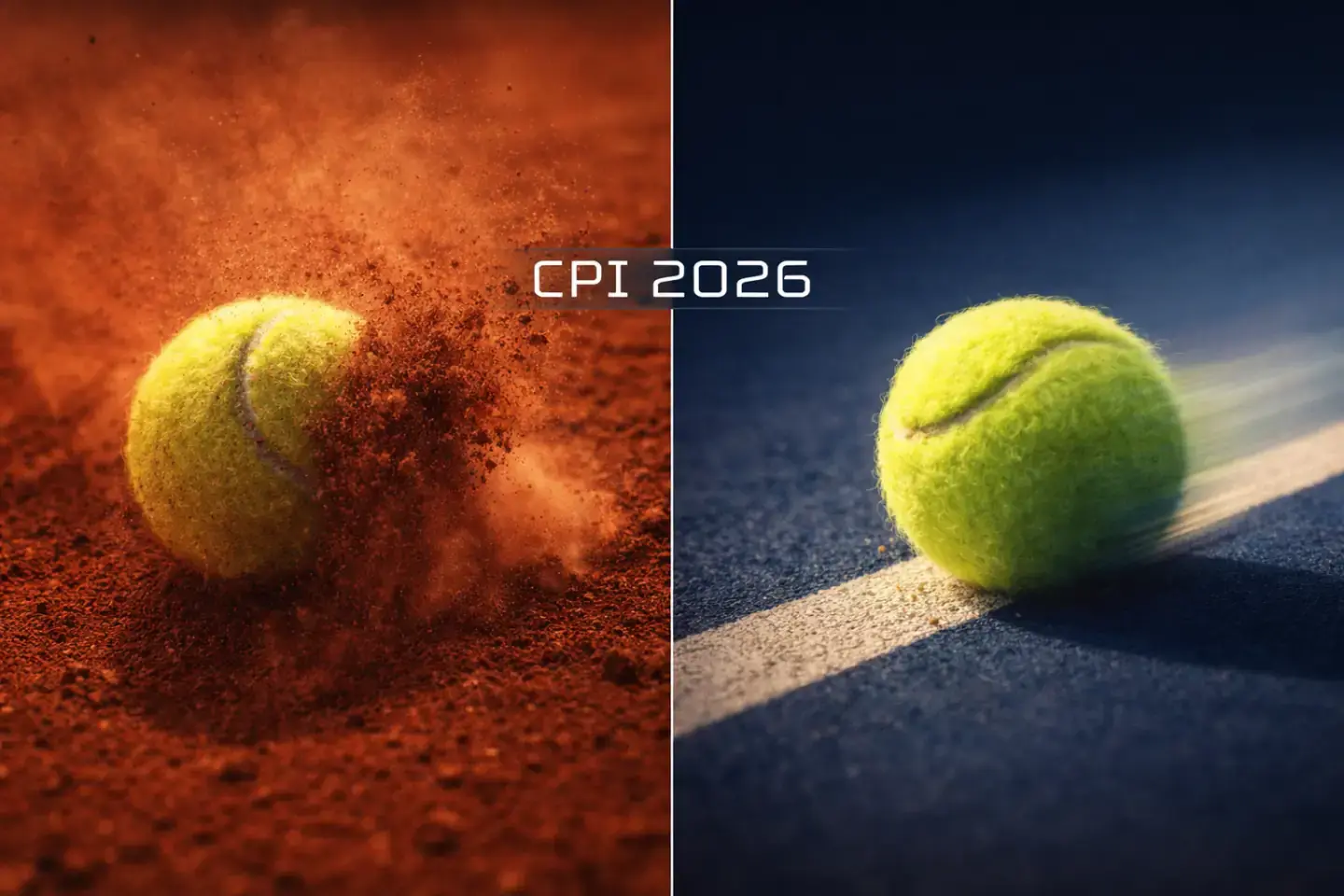
1. Understanding the Physics: CPI vs. CPR
In the 2026 landscape, the ITF Court Pace Rating (CPR) and the Hawk-Eye Court Pace Index (CPI) are the two most critical data points for gear selection.
CPR (The Surface): An objective measure of the court itself—how much the acrylic or clay slows the ball via microscopic friction.
CPI (The Conditions): A real-time calculation of how fast the court plays right now, factoring in barometric pressure, temperature, and ball age.
Technical Insight: High humidity in 2026 is often misunderstood. Humid air is actually less dense than dry air, meaning the ball travels faster through the air but feels "heavy" due to the strings absorbing moisture and the ball felt becoming "fluffed."
2. The 2026 ITF Master Classification Chart
Classification of the inherent speed of tennis court surfaces is vital to ensure appropriate playing conditions.
| Speed Category | CPI Range | 2026 Representative Venue | Recommended Racket Profile |
|---|---|---|---|
| Category 1: Slow | ≤ 29 | Roland Garros (Red Clay) | Flexible frames (RA < 62), 16x19 pattern |
| Category 2: Med-Slow | 30 - 34 | Indian Wells / Gritty Hard | Balanced frames, Mid-weight (305g) |
| Category 3: Medium | 35 - 39 | ATP Finals (Acrylic) | All-around "Standard" specs (100sq in) |
| Category 4: Med-Fast | 40 - 44 | Australian Open 2026 | 98sq in, High Swingweight (330+) |
| Category 5: Fast | ≥ 45 | Wimbledon (Grass) | Head-light balance, 18x20 pattern |
3. The "Dwell Time" Crisis: Why Power Rackets Fail
On the Medium-Fast courts dominating the 2026 tour, the biggest mistake is using a "Power" racket (stiff beams, RA 70+) like the Babolat Pure Drive.
The Physics of Impact: When a ball hits a fast surface, it retains higher horizontal velocity. If your racket is too stiff, the Dwell Time—the milliseconds the ball is in contact with the strings—decreases significantly.
Result: The ball "pings" off the strings before you can finish your swing path, leading to erratic depth.
The 2026 Solution: Shift to "Control Hybrids" like the Wilson Blade 98 v9 or Head Speed Tour 97. These frames "cup" the ball, increasing dwell time and providing the surgical precision needed for fast-paced rallies.
4. Advanced Racket Customization: Lead Tape Tactics
Most players don't need a new racket; they need Technical Tuning.
Increasing "Plow-through" for Slow Courts (Category 1-2): On slow courts, the surface "grabs" the ball. You need mass to drive through the heavy bounce.
- Lead Tape at 12 o'clock: Adding 3g at the tip increases swingweight by roughly 10 points. This provides the "hammer effect" needed to crush winners on slow clay.
Torsional Stability for Fast Courts (Category 4-5): On fast courts, the ball is coming at you. The racket wants to "flutter" or twist in your hand.
- Lead Tape at 3 & 9 o'clock: This increases Twistweight. It expands the sweet spot horizontally and prevents the frame from twisting on 120mph serve returns.
5. 2026 String Science: Gauge and Tension Dynamics
The "2026 Tennis String Report" confirms a massive shift: Playability is the new Spin.
String Snapback and Surface Grit: On high-grit surfaces (Clay/Slow Hard), the friction between the ball and the strings is high, but the friction between the strings is also a factor.
- Slow Courts (Thinner Gauges): Use a 1.20mm (18g) string. Thinner strings have less surface contact with each other, allowing for faster Snapback. This snapback generates the heavy RPMs (Revolutions Per Minute) required to make the ball "jump" on a slow court.
- Fast Courts (Thicker Gauges): Use a 1.30mm (16g) string. Thicker strings offer more "deadness" and durability, helping you absorb the high-speed impact of Category 5 surfaces without the stringbed becoming a trampoline.
6. The "Hy-Bor" Revolution: Stability in the 2026 Market
A major hardware update for the 2026 season is the introduction of Hy-Bor construction (Carbon + Boron) in elite shafts. Boron fibers are significantly stiffer than standard carbon, but when used sparingly in the shaft, they eliminate "frame flutter" on off-center hits.
Why this matters for CPI: On fast (Category 5) courts, the impact force is high. Hy-Bor technology ensures that even if you miss the sweet spot by 1cm, the racket face remains square to the target, preserving your directional control.
7. Bio-Mechanical Alignment: Swing Speed vs. CPI
Your physical swing speed must be calibrated to the court's pace.
- High CPI (Fast): Shorten your backswing. The court provides the power; your job is to redirect it.
- Low CPI (Slow): Full, loopy swings are necessary to generate the pace the court is stealing from the ball. Use a racket with a Lower RA (more flex) to help your arm handle the higher physical load of generating all that internal power.
8. Case Study: The 15% Performance Edge
Player Profile: Marcus, Competitive 4.5 Player. Scenario: Transitioning from high-altitude fast courts to sea-level slow courts. Problem: Marcus felt he had no "pop" on his ball. He was over-swinging and developed elbow pain.
The AceFinder Solution: Our AI analyzed the local CPI (Category 2) and recommended:
- Lowering tension from 54 lbs to 48 lbs to increase ball pocketing.
- Switching to a 1.20mm gauge for more "snapback."
- Adding 2g of lead at 12 o'clock for plow-through.
Result: Marcus regained 4 feet of depth on his groundstrokes, won the tournament, and his elbow pain vanished.
9. Pro Gear Maintenance: Protecting Your ROI
High-frequency players (3+ times a week) often overlook gear fatigue.
Racket Fatigue: Carbon fiber frames lose roughly 1-2% of their stiffness every year. In 2026, we recommend replacing your primary match frames every 24 months to maintain "spec" integrity.
Grip Hygiene: Replace overgrips every 3-5 hours of play in 2026. Sweat and oils degrade the tackiness, forcing a "death grip" that leads to tennis elbow.
10. FAQ: What Every 2026 Player Asks
Q: How do I know my local court's CPI? A: Observe the ball's skid. If the ball stays low and "slides" after the bounce, it is likely Category 4 or 5. If it "jumps" up and slows down, it is Category 1 or 2.
Q: Does altitude affect the CPI? A: Indirectly. While CPI measures the surface, higher altitude means lower air density, making the ball reach the court faster and skid more, effectively "feeling" like a faster Category.
Q: Is the Wilson Blade or Head Speed better for all-around play? A: According to our 2026 database, the Head Speed MP is the most versatile "Surface-Neutral" frame, while the Blade 98 excels specifically on Medium to Fast surfaces.
Conclusion: Data-Driven Dominance
In the top 0.1% of tennis, matches are won in the "margins." Understanding the Court Pace Index isn't just for pros—it's for anyone who wants to stop fighting their gear and start fighting their opponent.
Ready for your custom 2026 spec? Launch the AceFinder AI Matcher and get a surface-optimized recommendation in under 60 seconds.
Sources & Technical References
- Laykold Technical Services: Court Pace Classifications and Precision Standards for Professional Venues. View Source
- ITF Court Surface Assessment Programme: Surface Types and CPR (Court Pace Rating) Testing Methods. View Source
- ITF Rules of Tennis: Official Classification for Speed Category 1-5 (2026 Revision). View Source
AceFinder PickEst. £185 - £205
Pure Drive Gen11
300g 100" 16x19
Recommended for you
Technical Data Pairs
Match your swing speed to a frame.
Our lab-data analyzer compares your biometric inputs against 2026 racket physics.
Launch Racket Finder