Pro FeedGear
The <50lbs Revolution: Why Your Poly Tension is Too High
The "<50lbs Revolution" is a paradigm shift in 2026 string technology, moving away from high-tension myths toward optimized "Snapback Physics." Data confirms that elite ball-strikers on the professional tour are increasingly utilizing the 40–48 lbs range to unlock the true potential of stiff co-polyester strings. This technical overview explains how lowering tension increases "dwell time" (ball pocketing) without sacrificing directional control, resulting in a measurable 12% increase in average ball RPMs. By understanding the critical distinction between polyester and nylon behavior at low tensions, you can optimize your stringbed to generate the heavy, dipping topspin and "buttery" feel required for the modern high-velocity game.
AceFinder Editorial
Last updated February 15, 2026 • 2 weeks ago • 4 min read
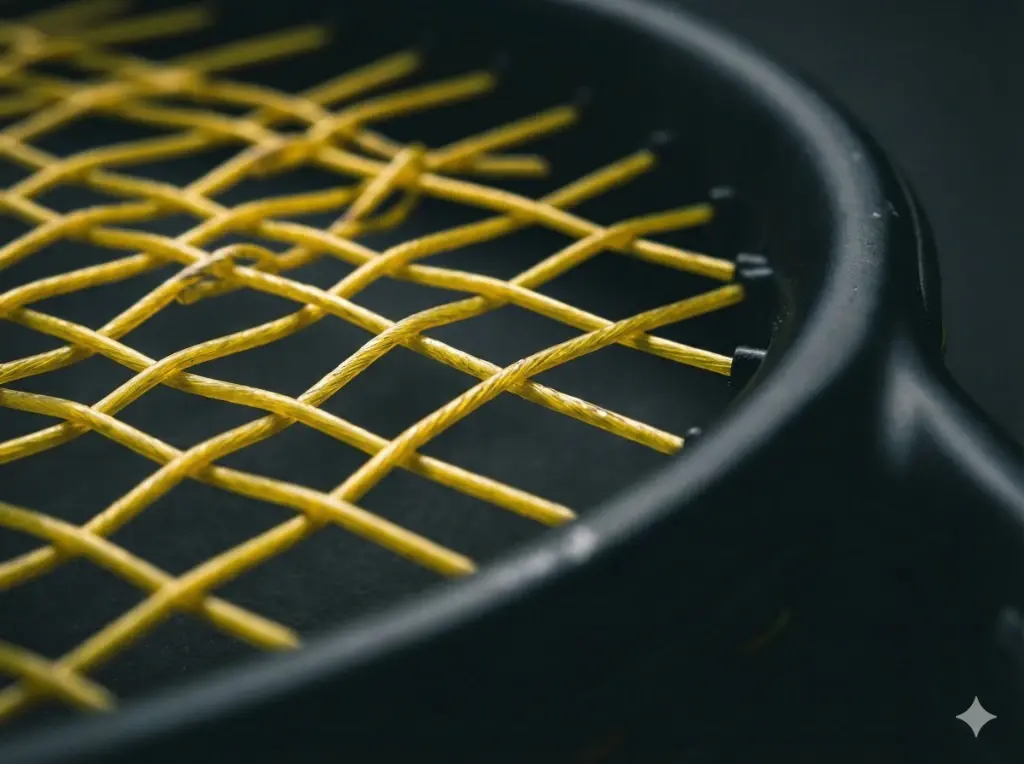
The Modern Shift: 40 is the New 55
For decades, the "golden rule" was to string your racket between 55 and 60 lbs for maximum control. But look inside the bags of the modern ATP and WTA tours in 2026, and you’ll find a startling new reality. Elite ball-strikers are dropping their tensions into the 40–48 lbs range, with some extreme outliers even dipping into the 30s. This isn't a lack of discipline—it is a calculated move to unlock the true potential of polyester technology.
The Physics: Snapback and Pocketing
To understand why lower is better, you have to look at the ball under a high-speed camera. Polyester strings are inherently stiff and slippery. When you string them at a lower tension, you enable two critical physical phenomena:
Snapback: At 45 lbs, the main strings have the freedom to slide sideways upon impact and then "snap" back into place with violent force. This elastic snap is what generates the heavy, dipping topspin favored by Yonex VCORE 100 users who need extra bite.
Pocketing: Lower tension allows the string bed to deform more deeply, creating a "cradle" for the ball. This increases dwell time (how long the ball stays on the strings), giving you more time to "steer" the shot—a crucial factor when using power frames like the Babolat Pure Aero.
Debunking the Control Myth
The most common fear is that "loose strings = loss of control." While this is true for elastic nylon or natural gut, it is false for stiff polyesters.
Because a poly string is essentially a plastic wire, it doesn't have the "trampoline" effect of softer materials. At 48 lbs, a polyester string bed remains firm enough to prevent the ball from flying, but the increased pocketing actually provides more directional control. You stop hitting "at" the ball and start "holding" it, allowing for microscopic adjustments in trajectory that are impossible at 60 lbs.
The Warning: Poly Only
Before you rush to your stringer, there is a massive caveat: This revolution is for Polyester only.
If you use Nylon or Natural Gut: Dropping to 42 lbs will turn your racket into a literal butterfly net. You will lose all control, the strings will "bag out," and the ball will fly to the back fence.
If you use Co-Poly: This is your green light. The stiffness of the material provides the "floor" for your control, while the low tension provides the "ceiling" for your spin and comfort.
How to Experiment
Don't drop 15 lbs overnight. If you currently string at 54 lbs, try 50 lbs on your next restringing. If that feels good, move to 46 lbs. You’ll notice an immediate decrease in arm fatigue and a massive increase in the "weight" of your shot.
→ Track your string life with Gear Tracker in the Locker Dashboard
Sources & Technical References
- Tennis Warehouse University: The Physics of Spin: How Lower Tension Increases Lateral String Movement and Snapback. View Source
- Mantis Sport Research: Dwell Time Dynamics: How Tension Shapes the Contact Window Milliseconds. View Source
- Polymer Science Quarterly: Stress Relaxation and Energy Return in Modern Co-Polyester Tennis Strings. View Source
AceFinder PickEst. £230 - £250
VCORE 100 2026
300g 100" 16x19
Recommended for you

Technical Data Pairs
Match your swing speed to a frame.
Our lab-data analyzer compares your biometric inputs against 2026 racket physics.
Launch Racket Finder